
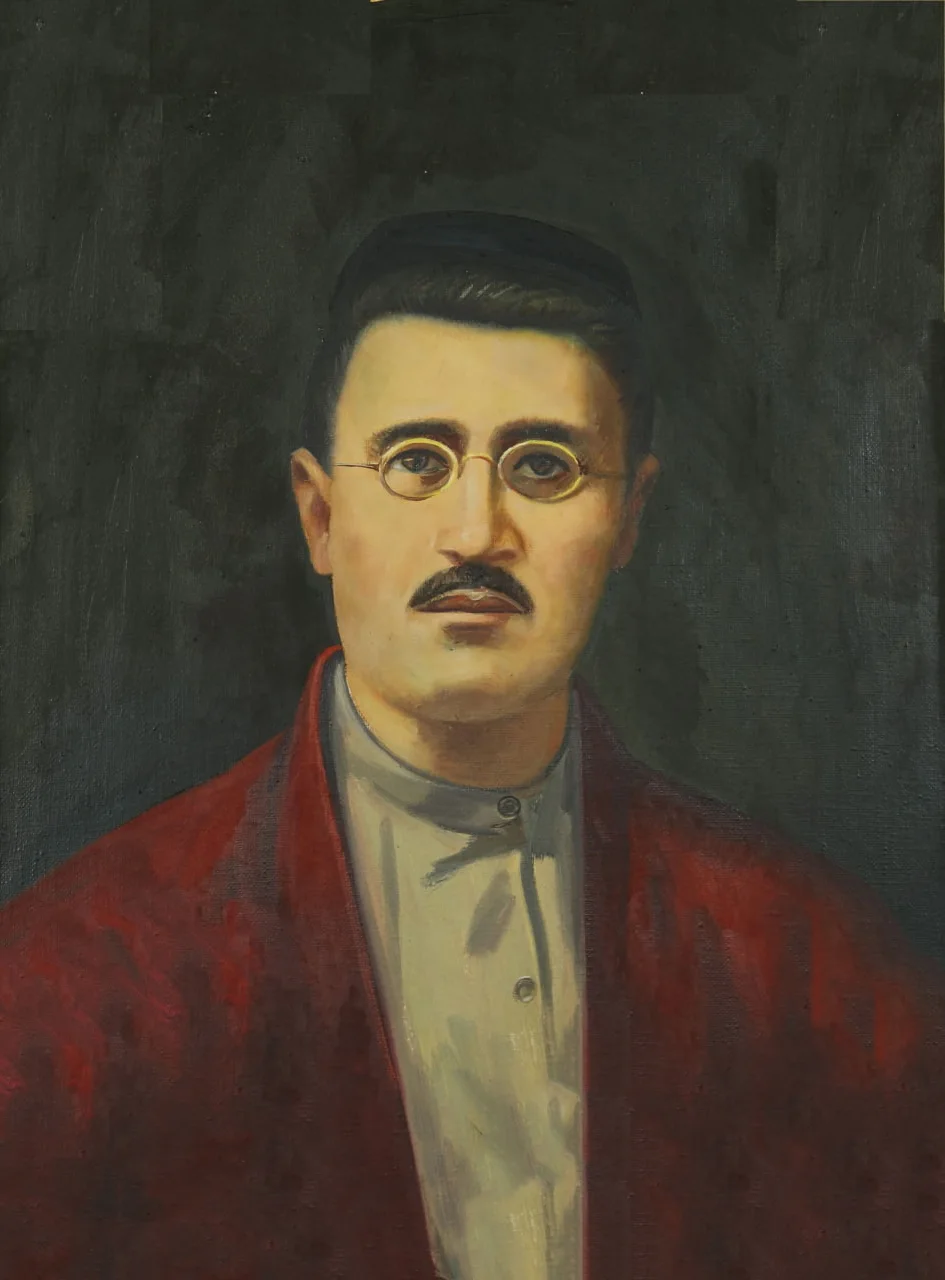
Cho'lpon — the pen name means "morning star" — was born Abdulhamid Sulaymon o'g'li Yunusov in Andijan in 1897. He studied in both traditional and Russian-native schools and was publishing poetry and journalism in his teens. He pulled Uzbek lyric verse out of classical convention into something recognisably modern, writing in a plain personal voice about longing and the state of his country. His collections Uyg'onish, Buloqlar and Tong sirlari shaped modern Uzbek poetry; he also wrote the novel Kecha va kunduz and translated Shakespeare. He was arrested in 1937 and executed on 4 October 1938.
A new music for an old language
Cho'lpon — born Abdulhamid Sulaymon o'g'li in Andijan in 1897 — did to Uzbek verse what his contemporaries were doing to schools. Classical poetry ran on inherited forms and a fixed stock of images; he wrote in a plainer, more personal voice about longing, doubt and the condition of his country, and made the language carry feeling directly. The collections Uyg'onish (Awakening), Buloqlar (Springs) and Tong sirlari (Secrets of Dawn) are where modern Uzbek poetry starts, and they are still the reason his name is spoken first among the Jadid writers.
Night and Day, and 4 October 1938
Beyond poetry he wrote stories, plays, criticism and the novel Kecha va kunduz (Night and Day), and translated Shakespeare's Hamlet into Uzbek. By the mid-1930s the charge of nationalism had attached itself to everything he had written. He was arrested in 1937 and shot on 4 October 1938 — the same day as Abdulla Qodiriy and Abdurauf Fitrat. Three of the founders of modern Uzbek literature were killed within hours of each other, and Uzbek writing did not recover the ground for a generation.
Key achievements
- Wrote Kecha va kunduz, a landmark of modern Uzbek prose
- Translated Shakespeare's Hamlet and works of Pushkin into Uzbek
- Executed in 1938; his poetry was banned for fifty years
Further reading
Opens on another website