
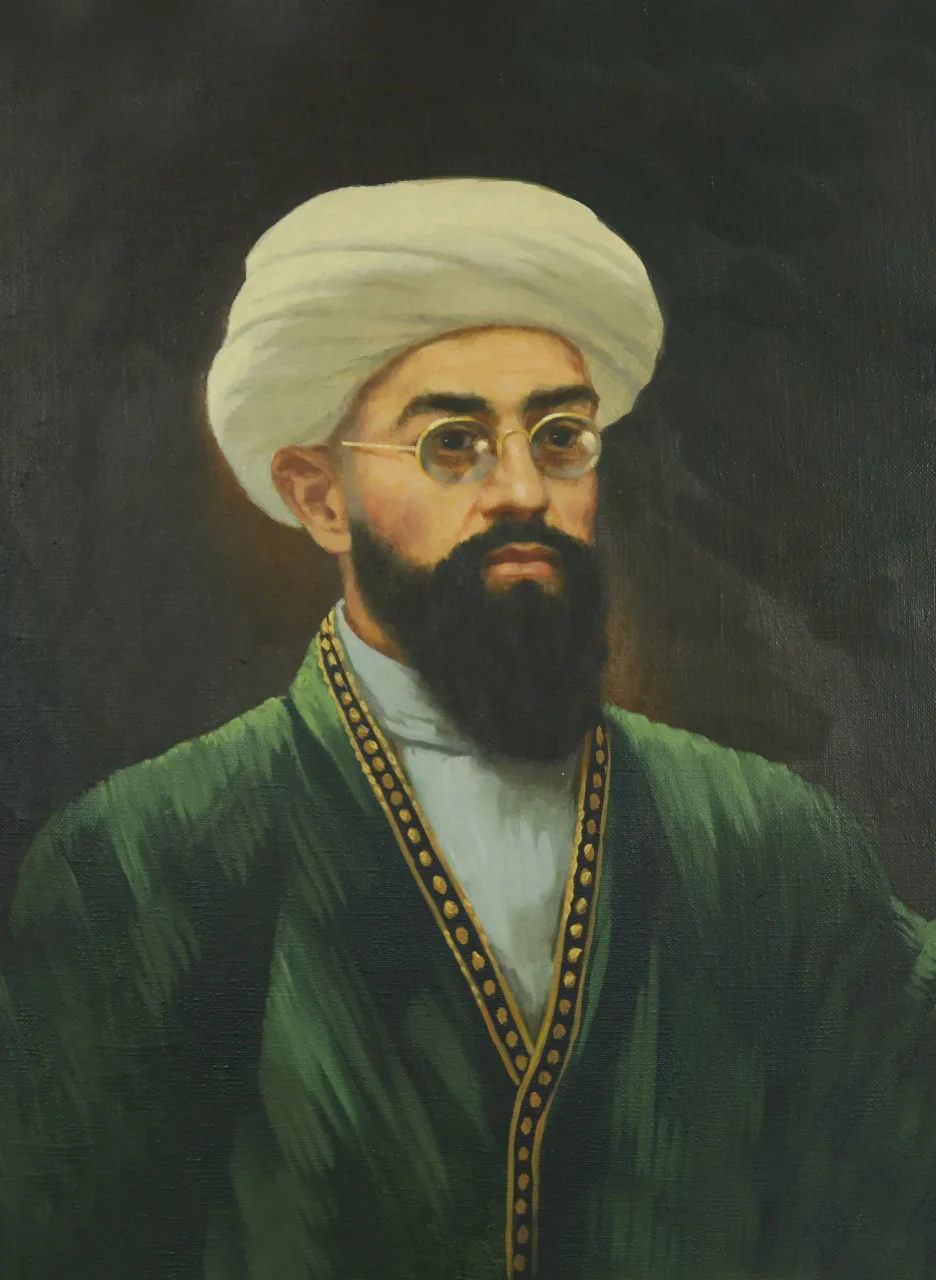
Born near Samarkand in 1875 into a family of religious scholars, Behbudiy received a traditional education and became a mufti. Travels to Istanbul, Cairo and the Hejaz in 1899–1900 showed him how far the Muslim world beyond Turkestan had already moved, and he returned determined to modernise education at home. He opened new-method schools, published newspapers and the magazine Oyna (The Mirror), and wrote Padarkush (The Patricide), the first modern Uzbek play. He was arrested by the Emir of Bukhara's men and executed at Qarshi in 1919.
The journey that changed him
Behbudiy trained in the classical madrasa curriculum and qualified as a mufti — a position of settled authority, not of dissent. What unsettled him was travel. Between 1899 and 1900 he crossed to Istanbul, Cairo and the holy cities, and found Muslim societies debating printing presses, girls' schools and constitutional government while Turkestan's madrasas still taught by rote memorisation. He came back with a conviction he held for the rest of his life: that the problem was not faith but ignorance, and that the remedy was a school with a blackboard, a timetable and a printed book.
Padarkush, and the birth of Uzbek theatre
In 1911 he wrote Padarkush — The Patricide — a short tragedy in which a rich man refuses to educate his son, and the uneducated son, fallen in with thieves, murders him for money. The moral is unsubtle by design: ignorance kills the generation that permits it. First staged in Samarkand in 1914, it was the first play written and performed in Uzbek, and it did something the newspapers could not — it reached people who could not read. Travelling troupes carried it across Turkestan, and Uzbek theatre effectively begins with it.
Death at Qarshi
Behbudiy's enemies were not only colonial. The Emirate of Bukhara saw the Jadids as a threat to clerical and dynastic authority, and after the failed reform push of 1917–18 the movement's leaders were hunted. Travelling in 1919, Behbudiy was seized by the Emir's officials and executed at Qarshi at the age of forty-four. He did not live to see the schools he argued for become ordinary. Nearly every Jadid who followed him — Fitrat, Cho'lpon, Qodiriy — was killed in turn twenty years later, by a different state with the same intolerance for independent minds.
Key achievements
- Wrote Padarkush (1911), the first modern Uzbek play, and staged it in Samarkand in 1914
- Founded the magazine Oyna and the newspaper Samarqand, cornerstones of the Turkestan press
- Opened new-method schools and wrote the textbooks they taught from
Further reading
Opens on another website