
The full story
Hamza Hakimzoda Niyoziy
Founder of modern Uzbek musical theatre
1889 – 1929
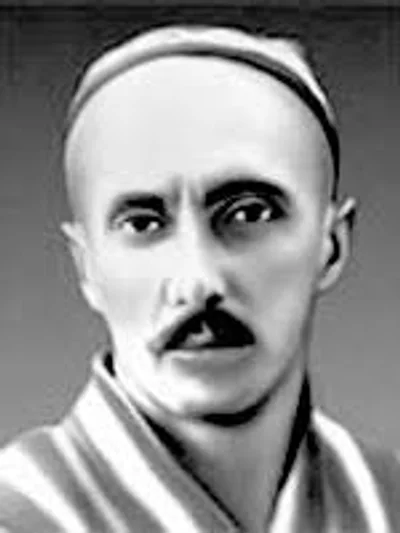
Hamza was born in Kokand in 1889 into a family of healers. He studied in traditional schools and madrasas before joining the Jadid movement, opening new-method schools in Tashkent, Kokand and Margilan and writing the textbooks for them. He wrote poetry, plays and songs, and is regarded as a founder of modern Uzbek drama and musical theatre; his work argued insistently for education, social justice and the position of women. Named People's Writer of Uzbekistan in 1926, he was killed at Shohimardon in 1929.
Songs that could be sung back
Hamza's particular contribution was to fuse the Jadid argument with music. Turkestan had a deep tradition of sung poetry, and he wrote for it directly — verses that could be learned by ear and carried home from a performance. His plays worked the same way, mixing song, spoken drama and recognisable local types. Where Behbudiy reached the literate through print and the illiterate through the stage, Hamza reached people through their own repertoire, which is why lines of his circulated in villages that had no school at all.
Shohimardon, 1929
Hamza spent his last years campaigning in the Fergana Valley for the unveiling of women and against the authority of local shrines — the most incendiary ground available in the region at that moment. In 1929 he was killed by a crowd at Shohimardon, a shrine village in the mountains. Soviet accounts made him a martyr of the campaign and named streets, a theatre and a district after him; later scholarship has looked more carefully at how deliberately he provoked the confrontation. Both readings agree on the outcome: he was forty years old.
Key achievements
- Regarded as a founder of modern Uzbek drama and musical theatre
- Opened new-method schools in Tashkent, Kokand and Margilan and wrote their textbooks
- Named People's Writer of Uzbekistan in 1926
Further reading
Opens on another website